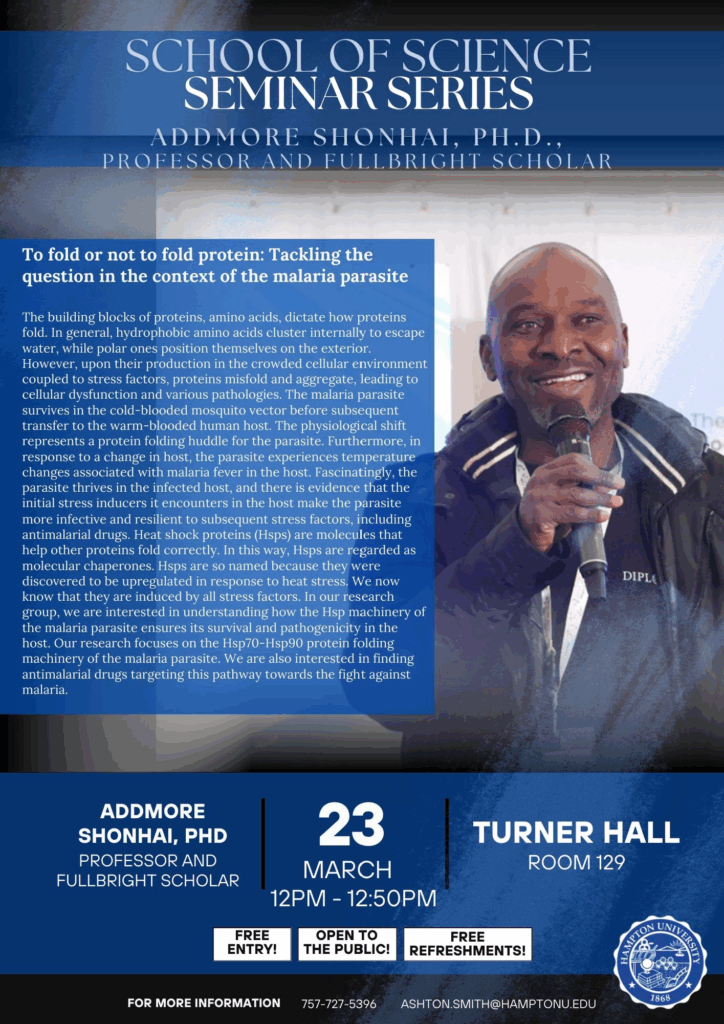
Addmore Shonhai, Ph. D., Professor and Fullbright Scholar, will present his research talk on Monday, March 23, 2026 at 12:00 PM in Turner Hall Room 129
Title: To fold or not to fold protein: Tackling the question in the context of the malaria parasite.
Abstract: The building blocks of proteins, amino acids, dictate how proteins fold. In general, hydrophobic amino acids cluster internally to escape water, while polar ones position themselves on the exterior.
However, upon their production in the crowded cellular environment coupled to stress factors, proteins misfold and aggregate, leading to cellular dysfunction and various pathologies. The malaria parasite survives in the cold-blooded mosquito vector before subsequent transfer to the warm-blooded human host. The physiological shift represents a protein folding huddle for the parasite. Furthermore, in response to a change in host, the parasite experiences temperature changes associated with malaria fever in the host. Fascinatingly, the parasite thrives in the infected host, and there is evidence that the initial stress inducers it encounters in the host make the parasite more infective and resilient to subsequent stress factors, including antimalarial drugs. Heat shock proteins (Hsps) are molecules that help other proteins fold correctly. In this way, Hsps are regarded as molecular chaperones. Hsps are so named because they were discovered to be upregulated in response to heat stress. We now know that they are induced by all stress factors. In our research group, we are interested in understanding how the Hsp machinery of the malaria parasite ensures its survival and pathogenicity in the host. Our research focuses on the Hsp70 Hsp90 protein folding machinery of the malaria parasite. We are also interested in finding antimalarial drugs targeting this pathway towards the fight against malaria.