
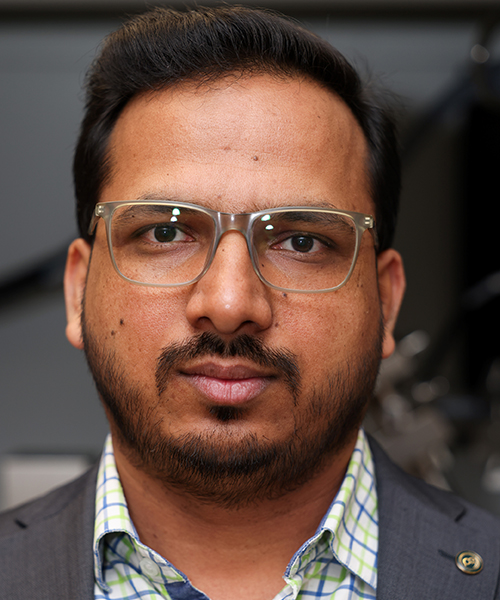
Dr. Bhausaheb Dhokale
- Assistant Professor
- Chemistry and Biochemistry
Areas of Expertise
Education
· Ph.D. in Organic Chemistry, Indian Institute of Technology (IIT) Indore, India (2015)
· M.Sc. in Organic Chemistry, Fergusson College Pune / Savitribai Phule Pune University, India (2009)
· B.Sc. in Chemistry, Adv. M.N. Deshmukh College Rajur / Savitribai Phule Pune University, India (2007)
About Dr. Bhausaheb Dhokale
Professional Appointments
· Assistant Professor, Hampton University, VA, USA (August 2025 – Present)
· Postdoctoral Researcher / Research Scientist, University of Wyoming, WY, USA (May 2022 – August 2025)
· Postdoctoral Researcher, Khalifa University of Science and Technology, Abu Dhabi, UAE
· Postdoctoral Researcher, Chalmers University of Technology, Sweden
· Postdoctoral Researcher, Indian Institute of Technology (IIT) Indore, India
Courses Taught
§ General chemistry (CHE 101)
§ General Organic Chemistry II (CHE 302)
§ Intermediate Organic Chemistry (CHE 407)
§ Organic Chemistry (CHE 605)
§ Advanced Organic Chemistry II (CHE 606)
Research Interests and Expertise
Dr. Dhokale’s research focuses on the design, multistep synthesis, and characterization of photoactive organic materials tailored for advanced photonic applications and organic electronics. With over 15 years of combined academic and industrial research and development experience, his laboratory bridges organic synthesis with materials science to address key challenges in electronic, optoelectronic, and energy technologies.
· Photoactive Materials & Organic Electronics: The lab investigates the photophysical and electrochemical properties of novel conjugated molecular architectures, with specific expertise in donor-acceptor systems. By systematically modifying synthetic structures, the research aims to establish precise structure-property relationships that optimize energy transfer, charge transport, and light-harvesting efficiency in thin-film organic devices.
· Materials Chemistry & Materials Design: Research activities focus on fabricating functional soft materials with responsive optical properties. This work combines rigorous organic synthesis with electrochemical profiling to develop high-performance materials for future optoelectronic applications.
· Covalent Organic Frameworks (COFs) Precision Design, Topology Control, and Advanced Photonic Applications: This research project focuses on the rational design, multistep synthesis, and structural engineering of highly crystalline, conjugated Covalent Organic Frameworks (COFs) tailored for next-generation photocatalytic solar water splitting. By transitioning molecular design principles from solution-state macrocycles to solid-state porous materials, this work aims to solve critical challenges in exciton migration and charge transport, creating highly stable, metal-free heterogeneous catalysts capable of driving efficient hydrogen evolution reactions (HER) and oxygen evolution reactions (OER) under visible light.
· Advanced Organic Fluorophores: By integrating Thermally Activated Delayed Fluorescence (TADF) and Multi-Resonance TADF (MR-TADF) mechanisms into highly engineered donor-acceptor systems, this work aims to maximize exciton utilization through efficient singlet-triplet upconversion (T1 to S1) while minimizing non-radiative energy loss. Beyond delivering high-performance, metal-free heterogeneous catalysts for visible-light-driven hydrogen evolution and ultra-pure, narrow-emission optoelectronics, these smart luminescent platforms are strategically designed for advanced biological applications. Specifically, by optimizing intersystem crossing (ISC) pathways to efficiently generate reactive oxygen species (ROS), these materials serve as highly potent agents for Photodynamic Therapy (PDT), alongside targeted bioimaging, theranostics, and fluorescent biosensing in living systems.
Links to My Research
· Google Scholar Profile: https://scholar.google.co.in/citations?user=EuJhrGgAAAAJ&hl=en&oi=ao
· Personal Webpage: https://sites.google.com/site/drbhausahebdhokale/home?authuser=0
Professional Affiliations
· American Chemical Society (ACS)