
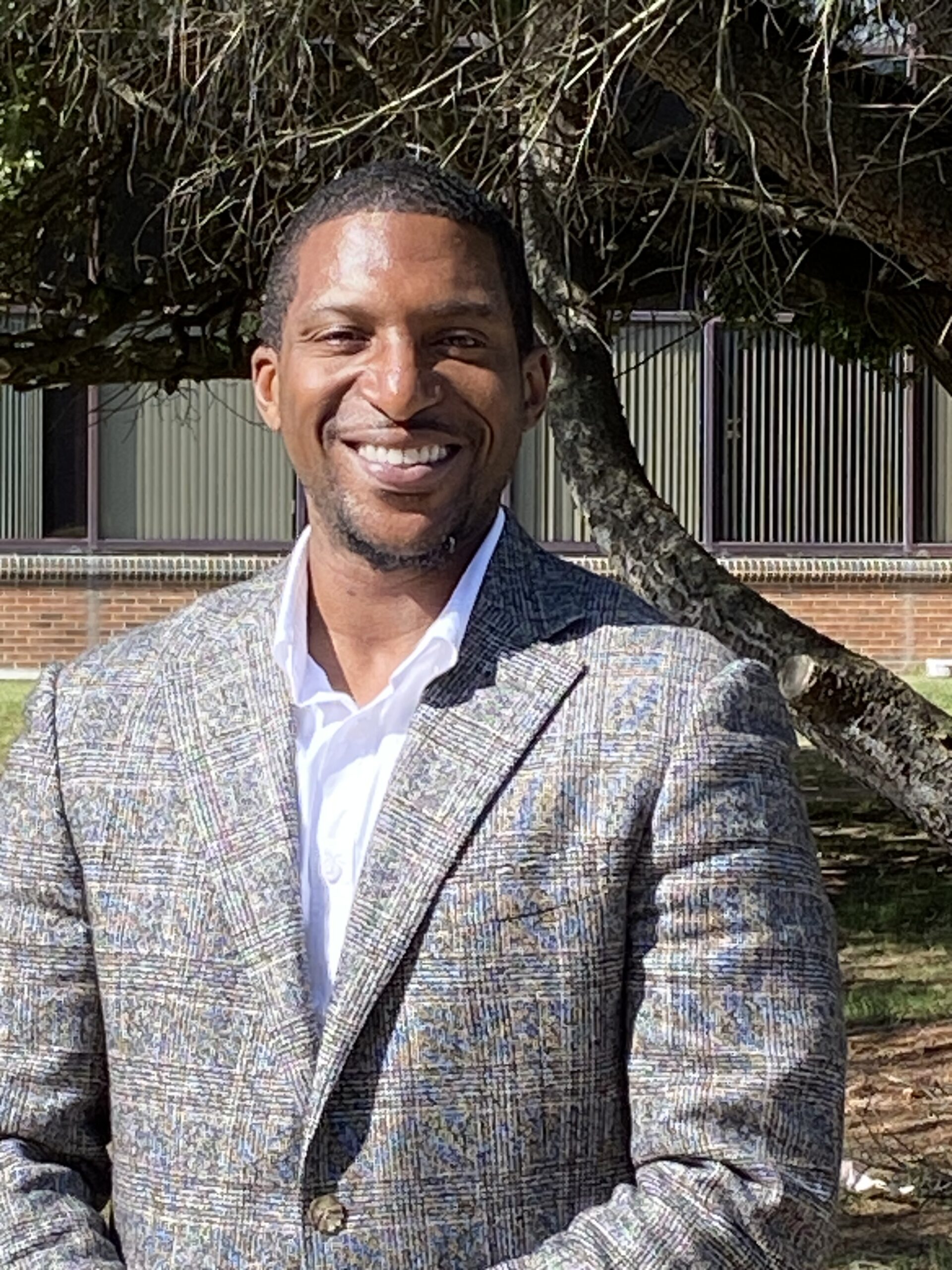
Lloyd M. Talley, Ph.D., M.S.Ed
He/Him/His
Assistant Professor / Black Male Psychology Initiative Coordinator / Research Capstone Co-Chair
About
Education
- Howard University, Bachelor’s, Communication & Culture
- University of Pennsylvania, Masters of Science, Education, Culture & Society
- University of Pennsylvania, PhD, Interdisciplinary Studies in Human Development
- Postdoctoral Fellow, Duke University, Samuel Dubois Cook Center on Social Equity
- Postdoctoral Fellow, University of Michigan, Curtis Center for Health & Health Equity
Courses Taught
- Introduction to Psychology
- Black Child Development
- Motivation and Well-Being
- Research Capstone 1
- Research Capstone 2
- Research Methods In Psychology
Areas of Expertise
- Black Boys’ and Men’s Development & Flourishing
- Risk, Resilience and Prevention Science
- Digital Health and Technology’s Impact on Well-Being
- Stress, Coping, and Motivation Across the Lifespan
- Community-Based and Culturally Grounded Interventions
Research Interests
I³–HubHL Research Collective
Membership Expectations
Participation in either arm of the Collective is by invitation only. Students are recommended to first complete a course with Dr. Talley, maintain a minimum 3.0 GPA, and have prior coursework in Research Methods, Introduction to Psychology, and at least one of the following: Developmental Psychology, Physiological Psychology, or Black Child Development.Publications
Burns, J. C., Sweet-Jemmott, L., Darbes, L., Talley, L. M., Wilson, D. M., Ploutz-Snyder, R., & Jemmott, J. B. (2025). Exploring condom use intentions among urban Black emerging adult men. Nursing Outlook, 73(3), 102432. https://doi.org/10.1016/j.outlook.2025.102432
Brawner, B.M., Talley, L.M., Baker, J.L., Bowleg, L., Dominique, T.B., Robinson, D.Y., Riegel, B. (2022). A Convergent Mixed Methods Study of Cardiovascular Disease Risk Factors among Black Emerging Adult Men in the United States. Ethnicity & Disease
Watkins, D. C., Goodwill, J. R., Johnson, N. C., Casanova, A., Wei, T., Allen, J. O., Williams, E.G., Jackson, Z., Talley, L.M. & Abelson, J. M. (2020). An Online Behavioral Health Intervention Promoting Mental Health, Manhood, and Social Support for Young Black Men: The YBMen Project. American Journal of Men’s Health, 14(4)
Stevenson, H.C., Jemmott, L.S., Jemmott, J.B., White, S.L., Talley, L.M. Chittamuru, D., Kim, S., O’Leary, A. (2020) Efficacy and Mediation of a Racial Literacy-Infused Barbershop-based Intervention to Reduce Violence Retaliation for Young African American Men: A Cluster-Randomized Controlled Trial. Cultural Ethnic Diversity and Minority Psychology
Baker, J. L., Stevenson, H. C., Talley, L. M., Jemmott, L.S., & Jemmott, J. (2018) Development of a barbershop based violence intervention for young Black emerging adult men. Journal of Community Psychology.
Slaughter-Acey, J. C., Talley, L.M., Misra, D. (2018) Personal versus group experiences of racism and risk of delivering a small-for-gestational-age infant in African American women, a life course perspective. Journal of Urban Health
Talley, L. M., Vogel, S., James, S., Ray, S. J., Crawford, C., Vogelstein, L., Hoadley, C., Barrales, W., Jones, S. T., & Computer Science Educational Justice Collective. (2025). Building your computer science education equity toolkit. In CS Educational Justice Collective (Ed.), Advancing educational equity in computer science: A guide for educators and their allies (Digital edition). SUNY Press. https://aeecs.pressbooks.sunycreate.cloud/chapter/chapter-6/
Talley, L. M., Vogel, S., James, S., Ray, S. J., Crawford, C., Vogelstein, L., Hoadley, C., Barrales, W., Jones, S. T., & Computer Science Educational Justice Collective. (2025). Setting your computer science equity commitments. In CS Educational Justice Collective (Ed.), Advancing educational equity in computer science: A guide for educators and their allies (Digital edition). SUNY Press. https://aeecs.pressbooks.sunycreate.cloud/chapter/chapter-7/
Talley, L. M., & Computer Science Educational Justice Collective. (2025). Getting started with digital racial literacy in computer science education. In CS Educational Justice Collective (Ed.), Advancing educational equity in computer science: A guide for educators and their allies (Digital edition). SUNY Press. https://aeecs.pressbooks.sunycreate.cloud/chapter/chapter-8/
Talley, L. M., & Computer Science Educational Justice Collective. (2025). Applying digital racial literacy in computer science education. In CS Educational Justice Collective (Ed.), Advancing educational equity in computer science: A guide for educators and their allies (Digital edition). SUNY Press. https://aeecs.pressbooks.sunycreate.cloud/chapter/chapter-9/
Talley, L. M., & Computer Science Educational Justice Collective. (2025). Auditing your digital racial literacy practice. In CS Educational Justice Collective (Ed.), Advancing educational equity in computer science: A guide for educators and their allies (Digital edition). SUNY Press. https://aeecs.pressbooks.sunycreate.cloud/chapter/chapter-10/ Computer Science Educational Justice Collective. (2025). Advancing educational equity in computer science: A guide for educators and their allies (Digital edition). SUNY Press. https://aeecs.pressbooks.sunycreate.cloud/
Warren, C. A & Talley, L.M. (2016). “Nice White Ladies”: Race, Whiteness, and the Preparation of a More Culturally Responsive Teaching Force. In S. D. Hancock & C. A Warren (Eds.). White woman’s work: Examining the Intersectionality of Teaching, Identity, and Race. Charlotte, NC: Information Age Publishing
O’Leary, A., Talley, L.M., Frew, P. (2016) Preface. In O’Leary & Frew, P. (Eds.), Poverty in The United States: Voices of Women (pp. xx-xxv.) Atlanta, GA: Springer
Personal Accomplishments
- NSF-Funded Project – Participating in Literacies and Computer Science (Award #1837446), served as content lead and racial literacy expert, integrating identity frameworks into professional development
- National Science Foundation (NSF) Professorial Advancement Fellow – University of Michigan (2020).
- Postdoctoral Fellowship – James & Vivian L. Curtis Center for Health Equity, University of Michigan
- Postdoctoral Fellowship – Samuel DuBois Cook Center on Social Equity, Duke University
- William E. Arnold Award for Outstanding Contributions by a Student, University of Pennsylvania (2018).
- Student Advocacy Award, University of Pennsylvania (2018).
- Provost’s Prize for Excellence in Teaching by Graduate Students, University of Pennsylvania (2017).
- Dean’s Doctoral Fellow, University of Pennsylvania (2014–2018).
- Dean’s Doctoral Fellow, University of Pennsylvania (2014–2018).
- Graduate School of Education Award for Outstanding Leadership, University of Pennsylvania (2014).
- Talley, L.M. (2020). Unpacking Risk and Resilience Among Black Emerging Adult Men: A Quantitative Intersectional Analysis. MLK’s Legacy for Behavioral and Social Research: Perspectives from New Scholars. Institute for Social Research, University Michigan, 2020. https://www.youtube.com/watch?v=ZRTDfArzBCs
- Talley, L. M. & Crawford, C., (2020, June 10). Decoding tech & race through racial literacy [Audio podcast episode]. In No Such Thing. Acast. https://podcasts.apple.com/us/podcast/decoding-tech-race-through-racial-literacy/id1279984850?i=1000477528650
Professional Affiliations
- American Psychological Affiliation
- Society for Research on Child Development
- Society for the Study of Emerging Adulthood
- American Education Research Association
- Dr. William Fontaine Minority Doctoral Scholar Society, University of Pennsylvania