
As America contends with rising temperatures, flooded cities, and increasingly violent storms, Hampton University is equipping students to meet one of the greatest challenges of our time: understanding and responding to extreme weather.
In the newly designed undergraduate course by associate professor Dr. Stephen Guimond, Physical Science 102/104: An Introduction to Climate Science, students are not only learning the basics of atmospheric physics—they are engaging in the applied science that drives forecasting, which can save lives, protect property and inform global climate policy. The course is part of a broader mission at Hampton to position its students and research faculty on the front lines of climate science and resilience, where science, innovation and urgency meet.
Each year, hurricanes carve destructive paths across the U.S. coastline. The National Oceanic and Atmospheric Administration (NOAA) reports that the frequency of Category 4 and 5 hurricanes has more than doubled since the 1980s, driven by warming oceans and shifting atmospheric conditions. Simultaneously, a sharp rise in “rain bombs”—sudden, intense rainfall events—has led to deadly flash flooding from Vermont to Las Vegas to Houston to Kerrville, Texas. In 2024 alone, flooding caused over $6 billion in damages nationwide, and scientists warn that this is just the beginning.
These escalating extreme events are redefining the way weather is studied, measured, and taught. Hampton University is responding with purpose.
Central to the curriculum in the climate science class is an exploration of how hurricanes form and intensify, with students learning about satellite instruments and Doppler radar systems mounted on aircraft . They are also gaining firsthand exposure to the real-time tools used by national weather agencies—a rare opportunity for undergraduates.
At the heart of this initiative is a groundbreaking research project led by NOAA engineers and Dr. Stephen Guimond, Associate Professor in the Department of Atmospheric and Planetary Sciences and Director of Hampton’s Severe Weather Research Center. His recently published paper in IEEE Transactions on Radar Systems details a next-generation airborne Doppler radar system that can detect and analyze small-scale turbulent winds within hurricanes.
These gusts of wind—technically referred to as “turbulence”—are often the most dangerous part of a hurricane. Responsible for toppling trees, tearing roofs from homes, and shattering windows, turbulence plays a central role in the destruction left in a storm’s wake. Dr. Guimond’s computer code can rapidly calculate the three-dimensional structure of these turbulent winds in real-time or near-real-time. This data is relayed to the National Hurricane Center (NHC), empowering meteorologists to issue faster, more precise warnings.
“Currently, legacy radar instruments onboard NOAA aircraft cannot measure turbulence, which is critical for the protection of life and property and understanding the physics of hurricanes,” said Dr. Guimond. “This new hardware and software technology for radar instrumentation can measure turbulence accurately and will ultimately lead to better warnings, improved forecasts and a more complete understanding of how hurricanes work.”
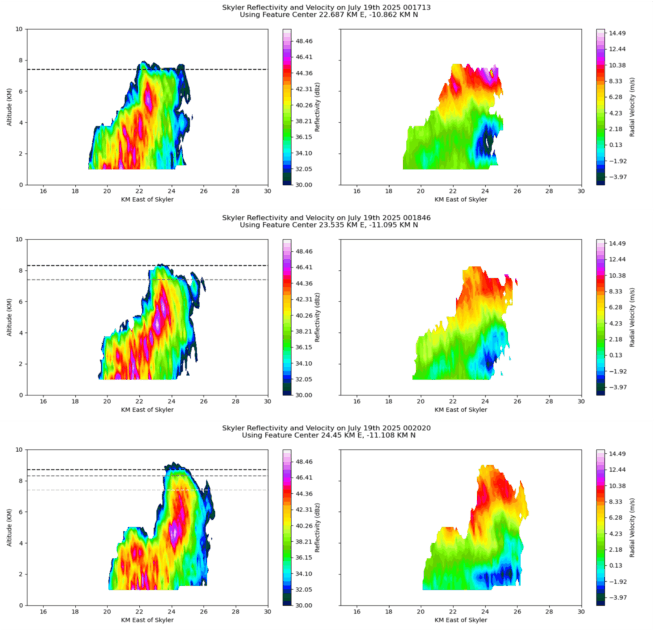
The radar hardware that enables this breakthrough has been in development for many years with recent improvements to optimize the measurements. Developed by a team of engineers, the phased array antenna captures high-resolution wind and precipitation fields, offering a level of detail previously unattainable in hurricane research. This same antenna technology powers the Skyler II Doppler radar, stationed atop the Harbor Center building in downtown Hampton. From this elevated vantage point, the radar monitors extreme weather across the Hampton Roads region, providing high resolution data to both researchers and students that exceeds the capabilities of local weather service offices
The collaboration between science and education at Hampton University is palpable. Students are not only learning the physics behind severe weather —they are participating in the data collection and analysis as well.
The Severe Weather Research Center serves as a hub for this research, hosting interdisciplinary projects that merge physics, applied mathematics, computer science and engineering. In a time when Black and Brown communities are disproportionately impacted by climate events—from New Orleans’ levee failures to flash flooding in New York’s urban corridors—Hampton’s investment in weather science is also an investment in equity.
“Our students aren’t just studying the storm—they’re shaping the future of how we respond to it,” said Hampton University President Darrell K. Williams. “This sort of research will have an impact on generations to come.”
As the country braces for another intense hurricane season, Hampton University continues to stand at the intersection of legacy, learning, and leadership. With faculty-driven research, student engagement, and technology designed to keep people safe, the university is not only preparing the next generation of atmospheric scientists—it’s helping to rewrite the future forecast.
Hampton University: A National Leader in Research, Innovation, and Opportunity
Hampton University is a prestigious Carnegie R2-designated research institution, nationally acclaimed for its pioneering work in atmospheric science, cancer treatment, and cybersecurity. With an annual economic impact of $530 million across the region and the Commonwealth of Virginia, Hampton stands as a powerful engine of innovation, workforce development, and inclusive economic growth.
Consistently recognized for academic excellence and transformative outcomes, Hampton was recently named one of the “Best Colleges in America” by Money Magazine and honored as the “Best Private College” by Coastal Virginia Magazine.
Founded in 1868, Hampton University is a proud, close-knit community of scholars, representing 44 states and 32 territories. With a legacy rooted in empowerment and education, the university is committed to nurturing intellectual curiosity, critical thinking, and global citizenship—preparing students to lead with purpose and integrity in an ever-changing world. Learn more at: www.hamptonu.edu
For media inquiries, please contact Mahogany Waldon in the Office of University Relations at 757-727-5987 or mahogany.waldon@hamptonu.edu
