School of Science

Physics

Illuminating how the universe works—one discovery at a time.

The Department of Physics offers a rigorous and inspiring pathway for students who want to understand the fundamental laws that shape our world—from the smallest particles to the vastness of space. Through Bachelor of Science, Master of Science, and Doctor of Philosophy degree programs, you gain the theoretical grounding, laboratory experience, and analytical skills needed for advanced study or direct entry into research, technology, engineering, or government careers.

Degree Programs

Select a degree program to take a look at the curriculum, course requirements, and application process.

News Spotlight

Hampton University is setting the scientific world ablaze with an electrifying breakthrough in fusion research, marking a historic leap for HBCUs and the future of clean energy. With the launch...
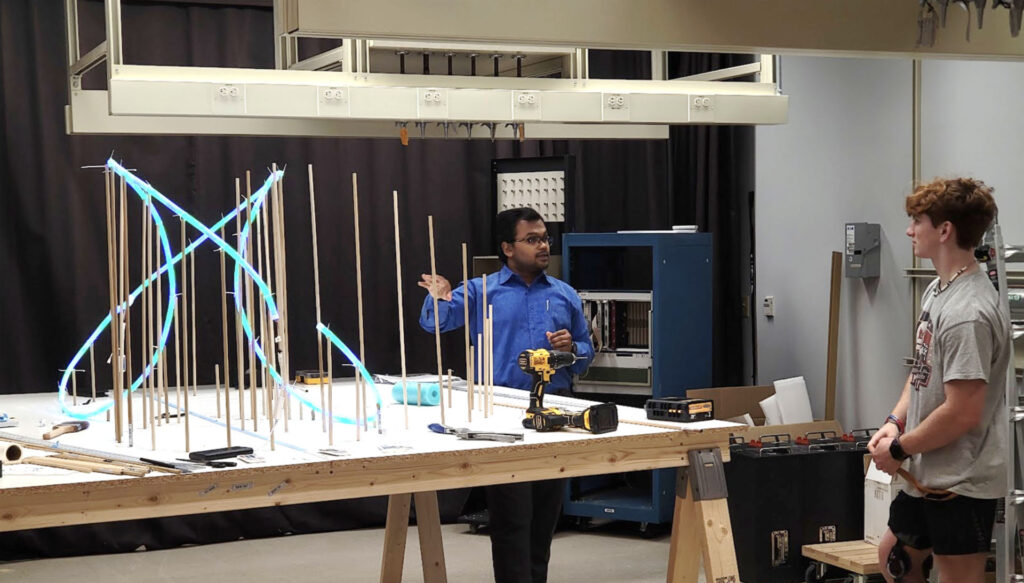
A student and professor stand around a diorama with blue lights displayed on a large, wooden table.

Exploring matter, energy, and innovation at every scale.

Research is a core pillar of the Physics program, offering you opportunities to work alongside faculty on studies that deepen scientific understanding and support technological progress. Whether your interests lie in theoretical physics, experimental research, materials science, or emerging interdisciplinary fields, the department provides an environment where inquiry drives discovery.

Advance the Frontier: Explore the Science Behind Motion, Energy, and Matter

Curious about how the world works—from the smallest particles to the vast universe? A degree in Physics equips you to explore big questions, drive innovation, and develop skills that open doors across science, technology, and industry. It’s a powerful foundation for students ready to think boldly and solve real-world problems.
Why Study Physics?
  • Engage in laboratory experiments, computational modeling, and research-driven coursework.
  • Build analytical and quantitative abilities valued across industries.
  • Prepare for graduate study or careers in engineering, data science, medicine, education, and research.
  • Learn in a supportive environment with personalized guidance and academic advising.
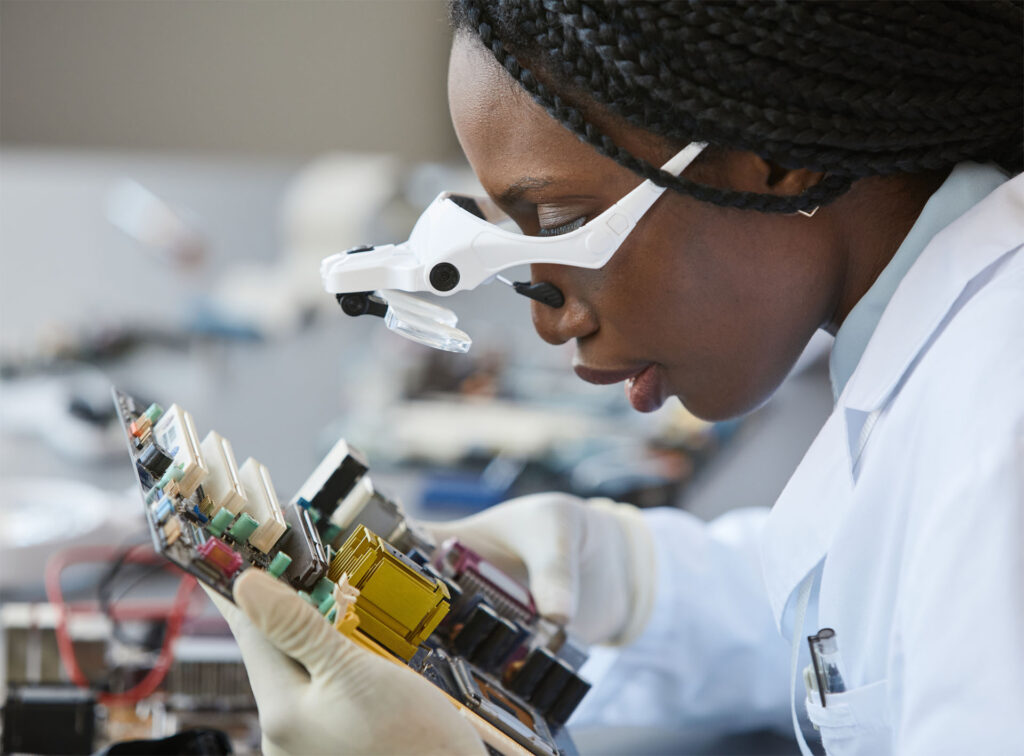
A student closely examines the circuitry on a motherboard.

Scholarship Opportunities

SPS is a professional association explicitly designed for students and their advisers, helping students transform themselves into contributing members of the professional community. They offer awards that are available to undergraduate physics and astronomy students on the basis of scholarship, SPS participation, and additional criteria.
Undergraduates
Undergraduate students, who qualify, will need to apply for university scholarships (either full or partial) during the admissions process. Grant funding within the department may be available to students based on need and academic standing. Students are encouraged to inquire.
Graduates
Graduate students, upon admission, can request financial support from the Center for which they will focus their research study. The Director will determine funding based on availability of funds. Stipends in the amount of $16K per calendar year are provided for qualified masters degree and Ph.D. candidates, and $18K for students who have successfully passed the Ph.D. qualifier examination.
Office of Financial Aid & Scholarships
The Office of Financial Aid & Scholarships has a list of scholarship opportunities for you to consider. Take a look at the Scholarship Search webpage for more information.
Do you have questions before you start your journey?
Reach out to the Undergraduate Academic Advisor Dr. Uwe Hommerich (uwe.hommerich@hamptonu.edu) for more information.

Our Team Members

Photo of Michael Kohl

Dr. Michael Kohl

Interim Chairperson and Professor
Areas of Expertise: Experimental Nuclear Physics, Nucleon and Few-Body Structure, Fundamental Symmetries

I am an experimental nuclear physicist with a joint position both as faculty at HU and as staff scientist at the Thomas Jefferson National Accelerator Facility (Jefferson Lab) located not far from the HU campus. My research interests are to explore the internal structure of protons, neutrons and light nuclei with the help of electron scattering and by utilizing spin degrees of freedom, which I have pursued at several laboratories – the Mainz Microtron (MAMI) at University of Mainz, Germany, the S-DALINAC at the Technical University of Darmstadt, Germany, the MIT-Bates Linear Accelerator Center in Middleton, Massachusetts, and now at Jefferson Lab in Virginia. The electron scattering process is usually described in the framework of one-photon exchange, which allows using this method to explore strongly interacting matter such as nucleons and nuclei and their internal structure generated by quarks and gluons. The unprecedented precision of spin-dependent electron scattering has recently led to the question to what extent the exchange of two or more photons in the scattering process influences the observations. A definitive experiment to resolve this question (OLYMPUS) will be carried out in the near future at DESY in Hamburg, Germany, a large facility providing intense electron (and positron) beams. OLYMPUS is designed to very precisely compare elastic scattering of electrons with that of positrons in a storage ring from an internal proton target.

Another major research area of mine is the search for New Physics beyond the Standard Model. The observed excess of matter over antimatter in the universe cannot be explained with the current Standard Model, which on the other hand does account for all symmetry violations observed so far. According to A. Sakharov’s criteria, discovery of new sources of symmetry violations (such as charge-parity or time reversal) are required for our understanding of the cosmos. I have co-initiated the Time Reversal Experiment with Kaons (TREK) proposed at J-PARC in Japan, which aims to find such new sources in the decay of charged kaons produced at J-PARC.

For both experiments OLYMPUS and TREK, my group is constructing charged-particle tracking detectors based on Gas Electron Multiplier (GEM) technology, a novel technique originally developed at CERN in Switzerland. GEM-detectors are relatively inexpensive, less fragile than wire chambers, and can be run at very high particle rates in very harsh radiation environments.

Photo of Aswini Pradhan

Dr. Aswini Pradhan

Associate Professor
Areas of Expertise: Quantum Materials, Semiconductor, and Superconductor
Photo of Calvin Lowe

Dr. Calvin Lowe

Research Professor
Photo of DeLiang Bao

Dr. DeLiang Bao

Assistant Professor
Areas of Expertise: Computational Condensed Matter Physics and Quantum Materials, First-Principles and Machine Learning-Driven Multiscale Simulations, Vibrational Properties and Emergent Phenomena in Low-Dimensional Nanomaterials
Photo of Edna Hogan-Hilton

Ms. Edna Hogan-Hilton

Administrative Assistant
Photo of Felix Jaetae Seo

Dr. Felix Jaetae Seo

Professor
Areas of Expertise: Interactions and dynamics of photon and localized energies in nanoscale materials and structures
Photo of Georg Friedrich Harrer

Dr. Georg Friedrich Harrer

Research Assistant Professor
Areas of Expertise: Plasma Physics, Fusion Energy, Plasma Edge Physics, Magnetohydrodynamic Stability, Plasma Diagnostics.
Photo of Hattie Session

Mrs. Hattie Session

Project Manager
Photo of Krishna Adhikari

Dr. Krishna Adhikari

Assistant Professor
Areas of Expertise: Experimental Nuclear Physics at Jefferson Lab (JLab) for understanding the fundamental structure of nucleons and nuclear matter in the framework of the Standard Model and its possible extensions.
Photo of Liguang Tang

Dr. Liguang Tang

Professor
Areas of Expertise: Experimental Hypernuclear Physics at JLAB
Photo of Ming Li

Dr. Ming Li

Assistant Professor
Areas of Expertise: Quantum Chromodynamics, Small x Physics, Gluon Saturation and Partonic Structure of Proton/Nucleus
Photo of Taviare Hawkins

Dr. Taviare L. Hawkins

Dean of the School of Science, Professor
Areas of Expertise: Experimental and Computational Biophysics, Microscopy, Nonlinear Systems Analysis and Human Computer Interfacing
Photo of Uwe Hommerich

Dr. Uwe Hommerich

Professor
Areas of Expertise: Luminescent Materials Development, Laser Spectroscopy, Crystal Growth
Your support fuels innovation in the School of Science. Contributions help create state‑of‑the‑art learning environments by funding new laboratories and providing advanced equipment that empowers students and faculty to push the boundaries of research and technology.